

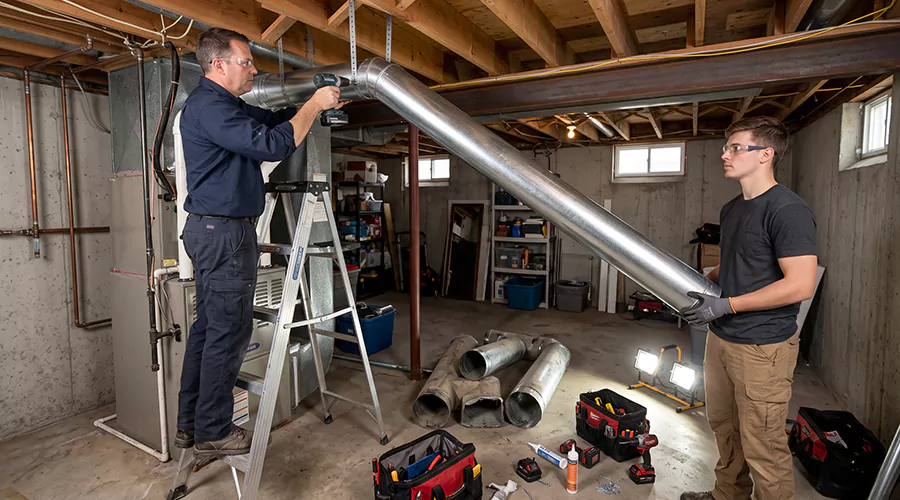
Basement ductwork replacement typically costs $1,800 to $3,100 for many residential projects in the United States in 2026. Replacing an individual duct run may cost approximately $270 to $500, while extensive replacement or work in a finished basement can cost considerably more. The final price depends on the amount of ductwork, material selection, accessibility, and whether the HVAC system needs changes to its existing layout.
Basements often contain the main supply and return ducts that connect a furnace or air handler to the rest of the home. In unfinished basements, these passages may be exposed along ceiling joists, making them easier to inspect and replace. Finished basements can be more complicated because ductwork may be concealed behind drywall, soffits, or suspended ceilings.
Duct replacement becomes necessary when the existing material is physically damaged or cannot provide the required airflow. Rusted metal, collapsed flexible sections, and severely deteriorated connections may need replacement. However, small leaks and loose fittings can often be repaired without removing entire duct runs.
Understanding the costs involved helps homeowners decide whether to replace one damaged section or undertake a larger system upgrade. A reliable estimate should identify the affected ducts and include appropriate fastening, sealing, insulation, and testing.
What Is the Average Cost to Replace Ductwork in a Basement?
HomeGuide's published residential replacement estimates place basement ductwork replacement between $1,800 and $3,100, including materials and labor. This location is often less expensive than an attic or crawlspace when the ducts are exposed and accessible. However, the price can rise when the basement is finished or the contractor must rebuild substantial parts of the air distribution system.
The number of ducts being replaced is a major factor. A homeowner may need only one damaged branch, while another property requires new main trunks and multiple supply connections. These projects should not be expected to have similar prices.
| Basement Ductwork Project | Estimated U.S. Cost |
|---|---|
| One straightforward duct run | $270–$500 |
| Typical basement ductwork replacement | $1,800–$3,100 |
| General duct replacement per linear foot | $25–$55 |
| Larger residential duct replacement project | $1,400–$5,600 across common home types |
| Repair of exposed basement ductwork | $150–$400 in some projects |
| Extensive concealed or custom replacement | Requires individual estimate |
These are planning ranges drawn from different categories of work. They should not be added together because a whole-project replacement quote may already include the individual ducts and fittings. Material selection, the amount of demolition, and local labor rates can change the actual total.
A contractor should provide an estimate based on the basement's duct layout. The quote should also state whether the existing system is being replaced with equivalent dimensions or redesigned to correct airflow problems.
How Much Does Basement Duct Replacement Cost per Linear Foot?
Published replacement estimates commonly range from $25 to $55 per linear foot for removing existing ductwork and installing new passages. Angi reports a lower $10 to $25 per-foot range in its 2026 national dataset, which includes different project sizes and materials. These figures illustrate why a contractor's work scope matters more than a single advertised rate.
The length of a duct is measured along its installed route. However, a fifty-foot system with numerous fittings can require more labor than a similar length of straight exposed ductwork. Large rectangular trunks also involve different material and installation costs from small round branches.
The following table uses a $25 to $55 per-foot replacement model.
| Ductwork Length | Illustrative Replacement Cost |
|---|---|
| 20 feet | $500–$1,100 |
| 30 feet | $750–$1,650 |
| 40 feet | $1,000–$2,200 |
| 50 feet | $1,250–$2,750 |
| 60 feet | $1,500–$3,300 |
| 80 feet | $2,000–$4,400 |
| 100 feet | $2,500–$5,500 |
These amounts are mathematical estimates, not guaranteed basement project prices. They do not separately account for custom transitions, finished ceiling repairs, or major design changes. A contractor may charge a fixed project price instead of calculating each foot individually.
The estimate should explain whether the per-foot rate includes removal, insulation, approved sealing materials, and supports. The cost of duct materials alone is not equivalent to the cost of a finished installation.
Is Duct Replacement Cheaper in an Unfinished Basement?
An unfinished basement often provides easier access to the duct network. Technicians may be able to see the main trunks and branch connections without removing ceilings or wall finishes. This can reduce labor and make it easier to identify which sections are actually damaged. Our air duct camera inspection service can document conditions inside the duct system when visual inspection is not enough.
For example, an exposed metal duct may have one corroded elbow or disconnected branch that can be replaced without disturbing nearby sound material. The technician can inspect the connection points directly and prepare the replacement with fewer access-related complications. The ability to inspect the system also makes it easier to document the reason for the work.
However, an unfinished basement does not automatically make every duct inexpensive to replace. Large trunks may require custom fabrication, and ducts installed around plumbing or structural obstacles can be difficult to remove. The number and size of replacement sections still determine a substantial portion of the cost.
How Much Does Finished Basement Ductwork Replacement Cost?
Finished basement replacement can cost more than work on exposed ducts because the contractor may need access through ceiling panels or drywall. The amount of added expense depends on how the ductwork is enclosed. A suspended ceiling with removable tiles may provide relatively easy access, while a finished drywall soffit may require cutting and restoration.
Opening a ceiling is not always necessary. Some replacement work can be performed through existing mechanical access points, depending on the route and fittings. The contractor should establish which areas must be opened before providing a final estimate.
Finished surfaces introduce costs outside the duct installation itself. Drywall repair, painting, and replacement of damaged ceiling materials may be handled by another contractor. These charges should be disclosed separately so homeowners understand the complete project budget.
A lower duct installation quote may not represent the least expensive overall option if it excludes substantial surface restoration.
What Factors Affect Basement Ductwork Replacement Costs?
The price of basement duct replacement reflects the amount of material and labor required to restore the air distribution system. The layout and physical condition of the ducts matter more than the basement's size alone. Several factors should be reviewed before a contractor recommends a complete replacement.
Type of Ductwork
Galvanized sheet metal is commonly used for main basement trunks because it provides a rigid air passage. Flexible ducts may connect certain branches to room registers where permitted by the design. Fiberglass duct board is also present in some systems.
Each material has different installation requirements. Metal ducts may require custom transitions and appropriate supports, while flexible ducts need careful routing to avoid sagging and compression. The contractor should select the material based on the system's airflow requirements and installation conditions.
Material quality also matters. An inexpensive flexible duct that is installed incorrectly can restrict airflow or become damaged prematurely. Proper sizing and workmanship affect the long-term value of the replacement.
Number of Branches and Main Trunks
A system with one supply trunk and several branches is generally less complicated than one containing multiple trunks and return pathways. Each replacement connection needs appropriate fittings and sealing. Changing several branches can also require airflow balancing after the work is complete.
Main duct replacement may involve disconnecting multiple branches before removing the damaged trunk. This can increase labor compared with replacing one independent run. The estimate should identify how many connections will be disturbed.
Replacing sound branches is not automatically necessary when a main section fails. A contractor should determine whether the existing connections can be reused safely and appropriately.
Ceiling Height and Working Clearance
A basement with exposed ceiling joists may provide reasonable access, but low clearances can restrict movement and equipment positioning. Ducts that pass around large plumbing pipes or structural beams may also require custom fittings. Installers must preserve the required space around other building systems.
Finished basements can create additional obstacles where ducts are installed inside narrow soffits. The replacement design should not require cutting structural members without appropriate authorization. A suitable transition may be needed to maintain airflow through a restricted area.
Extent of Damage
Small leaks and loose connections often require less work than extensive metal corrosion or widespread deterioration. When rust has weakened multiple sections, replacement may be necessary. A contractor should also investigate whether recurring condensation or water leakage caused the damage.
Replacing a damaged duct without correcting the moisture source can lead to another failure. The price may therefore include separate repair work that protects the replacement system.
Local Labor Rates
HVAC labor rates differ between cities and service providers. Some companies price replacement per run, while others develop a total based on materials and expected labor hours. Minimum service charges can affect small projects.
The most useful comparison involves written estimates based on similar materials and work scopes. Contractors should explain which components are included rather than present only one total amount.
Is Metal or Flexible Ductwork Better for a Basement?
Both materials can be appropriate when used according to the HVAC design and installation instructions. Metal is commonly chosen for main trunks because it retains its shape and can be fabricated into suitable rectangular or round sections. Flexible duct is often used for selected branches where gentle routing around obstacles is beneficial.
| Feature | Rigid Metal Ductwork | Flexible Ductwork |
|---|---|---|
| Common basement application | Main trunks and rigid branches | Selected branch runs |
| Structural strength | Maintains rigid shape | More vulnerable to crushing |
| Routing | Uses elbows and transitions | Accommodates gentle curves |
| Installation | May need custom fabrication | Often simpler for suitable runs |
| Airflow | Smooth passage when properly designed | Sensitive to sagging and compression |
| Insulation | May require separate insulation | Often supplied pre-insulated |
| Repair | Sound metal can often be patched | Extensive liner damage may require replacement |
The best choice depends on the available space and the amount of airflow required. Flexible duct should not be forced into a narrow cavity where its liner becomes compressed. A properly designed metal transition may be more suitable in that situation.
Basement moisture conditions also matter. Insulation should be selected and installed to control heat transfer and avoid condensation where necessary. Neither material eliminates the need to correct water intrusion.
What Additional Costs Can Affect Basement Duct Replacement?
A basement replacement project may reveal work that was not included in the initial duct estimate. The homeowner may need a damaged return box repaired or additional insulation installed. Finished ceilings can also require restoration after access openings are created.
Potential additional costs include:
- Custom metal duct fabrication and transitions
- HVAC airflow design calculations
- New return duct connections
- Replacement register boots
- Additional insulation or vapor protection
- Ceiling or soffit removal and restoration
- Permit and inspection fees
- Duct leakage and airflow testing
- Moisture-related repairs
- Specialized assessment of suspected asbestos-containing materials
Not every project requires these services. A straightforward replacement of an exposed branch may already include all necessary fittings and sealing work. The contractor should explain which additions are needed and obtain approval before proceeding.
Older duct wrapping deserves special attention. Some older insulating materials can contain asbestos, which cannot be confirmed by appearance alone. Suspected material should be assessed by qualified personnel before any disturbance.
When Should Basement Ductwork Be Replaced Instead of Repaired?
Replacement is usually appropriate when the duct has lost its structural integrity or cannot be restored through a durable repair. A metal trunk with extensive perforation may not provide a sound surface for sealing. A permanently crushed flexible branch may remain restrictive even after attempts to straighten it.
Repair can be more economical when the material remains sound. Loose fittings can often be mechanically reattached and sealed with compatible products. A small localized opening in otherwise suitable metal may also support an appropriate repair.
The contractor should document the affected sections and explain why replacement is needed. High energy bills or uneven temperatures alone are not sufficient evidence that all basement ducts must be removed. Filter restrictions, equipment problems, and air leaks should be evaluated before recommending a larger project.
What Is Included in Professional Basement Duct Replacement?
A professional replacement begins with checking the existing layout and determining which ducts require removal. The contractor should confirm the airflow requirements before selecting sizes and fittings. Installing new material with the same inadequate dimensions can leave existing comfort problems unresolved.
Damaged sections are then disconnected and removed while sound surrounding components are protected. New ducts are installed using appropriate hangers and mechanically secured connections. Joints are sealed using suitable HVAC mastic or listed closure products, and required insulation is restored.
Supply and return ducts should receive equal attention to airtightness. A return leak can draw air from unwanted locations, while a supply leak releases conditioned air before it reaches the room. The completed work should be checked for leakage and normal system performance.
When fuel-burning equipment is present, duct modifications can affect building pressure conditions. ENERGY STAR recommends appropriate combustion safety checks after substantial duct sealing or improvement work where backdrafting is a concern.
How Long Does Basement Duct Replacement Take?
A small exposed duct replacement may be completed within several hours, while a larger residential project commonly takes one to two working days. Finished basement access and restoration can extend the schedule. Custom fittings and design changes may also require additional preparation.
The contractor should explain whether the HVAC system will remain unavailable during the work. Replacement often requires disconnecting part of the air distribution network, so normal heating or cooling may need to stop temporarily. The schedule should account for household needs and expected weather.
Final testing should not be skipped to shorten the project. An installed duct can still contain leakage or a restrictive fitting. Inspecting the completed system helps identify these issues while they remain accessible.
Can Replacing Basement Ducts Improve Energy Efficiency?
Replacing damaged ductwork may improve performance when the original system contained substantial leakage or restrictions. ENERGY STAR estimates that typical homes lose about 20% to 30% of the air moving through ducts because of leaks and poor connections. Correcting these defects can help deliver more conditioned air to the intended rooms.
However, this estimate does not mean replacement will reduce an individual home's utility bill by the same percentage. The effect depends on the amount of leakage and the location of the ducts. A system located largely inside conditioned space may behave differently from one installed in an unconditioned area.
Repairing sound ducts can sometimes provide similar benefits at a lower cost. Sealing joints and correcting disconnected branches may be sufficient without replacing the entire network. The decision should follow the system's condition and measured performance.
How Can You Save Money on Basement Duct Replacement?
The most effective way to control cost is to avoid replacing sound sections unnecessarily. Ask the contractor to document rusted, crushed, or otherwise damaged ducts before recommending removal. A proposal for one damaged branch should be compared separately from a whole-system redesign.
Get at least two estimates based on the same materials and scope. Confirm whether sealing, insulation, removal, testing, and permit fees are included. A lower initial quote may be more expensive overall if it excludes important installation tasks.
If the basement is being renovated, coordinate duct changes before closing ceilings or constructing soffits. This can reduce repeated access and restoration work. However, the duct layout should still be based on suitable airflow design rather than simply the most convenient construction route.
Conclusion
Basement ductwork replacement commonly costs $1,800 to $3,100 for many residential projects, with smaller repairs and extensive installations falling outside that range. Exposed ducts are often less expensive to work on than passages concealed behind finished ceilings. The final price depends on material, length, access, and required design changes. Sound ducts with minor leaks may need repair rather than replacement. Before scheduling, request an inspection and an itemized quote that identifies the exact sections to be replaced.